
🛒 Best Price Today on Amazon
Prime members get fast, free shipping on everything above, plus member-only deals. New members get a 30-day free trial — cancel anytime.
Electric grills are a natural fit for places where charcoal and propane are banned, such as balconies, condos, and some campgrounds. They’re also a natural thing to want at a tailgate or an off-grid cookout. Unlike a pellet grill, which uses electricity only for its auger, fan, and igniter, an electric grill turns wall power directly into searing heat. Most draw 1,500 to 1,800 watts continuously while the element is on. That is a real load for a portable generator, and sizing for it is straightforward once you know the numbers.
Grill power draw compared
| Grill type | Running watts | Startup / igniter peak | Energy per 45-min cook |
|---|---|---|---|
| Countertop / indoor electric grill | 1,200-1,500W | Same as running | ~0.7-1.0 kWh |
| Outdoor pedestal electric grill | 1,500-1,800W | Same as running | ~0.9-1.3 kWh |
| Electric smoker | 800-1,500W | Same as running | ~0.4-0.8 kWh/hr (cycling) |
| Pellet grill (igniter phase) | 250-450W | Igniter for 3-5 min | – |
| Pellet grill (cooking) | 40-100W | – | ~0.05-0.1 kWh/hr |
An electric grill element has no motor, so there’s no startup surge. The generator sees the full rated load from the moment you turn the dial until the thermostat cycles. Preheating typically takes 10-15 minutes at full draw.

WEN 4,750-Watt 120V/240V Dual Fuel Portable Generator with Wheel Kit and Electric Start (DF475T)
Included for 'Best Generator for Running an Electric Grill' as a relevant option in this category; details come from the product listing.
View on Amazon
ComJoy 5500W Portable Inverter Generator for Home Use & Camping
Included for 'Best Generator for Running an Electric Grill' as a relevant option in this category; details come from the product listing.
View on Amazon
Champion 11,500-Watt Electric Start Dual Fuel Portable Generator
Included for 'Best Generator for Running an Electric Grill' because the listing specifies 500-Watt Electric Start Dual Fuel Portable Generator, details this guide uses to compare options.
View on Amazon
Pulsar PGD40ISCO Ultra Light Quiet 4000W Portable Gas Inverter Generator, white
Included for 'Best Generator for Running an Electric Grill' because the listing specifies white, details this guide uses to compare options.
View on AmazonGenerator picks
Best overall for a 1,500-1,800W electric grill: 2,800-3,500W inverter
A 1,800W grill on a 2,000W-class generator runs the engine near full output for the entire cook. It’s loud, thirsty, and prone to tripping if someone plugs in a blender. Stepping up to a roughly 3,000W inverter gives you 1,000W or more of headroom for lights, a speaker, or a slow cooker, with the engine running at a comfortable 50-60% load. Expect about 0.2-0.25 gallons per hour and 58-64 dBA at 23 feet, which is quiet enough for a tailgate lot.
Budget option: 2,000-2,300W inverter with a 1,200-1,500W grill
If you already own a small inverter, match it to a smaller countertop or tabletop electric grill. Many are rated at 1,200-1,500W. It works well as long as nothing else significant shares the generator.
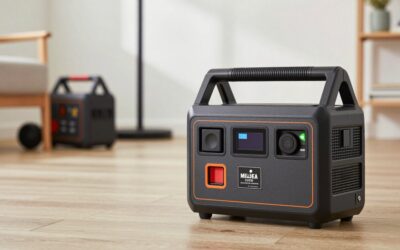
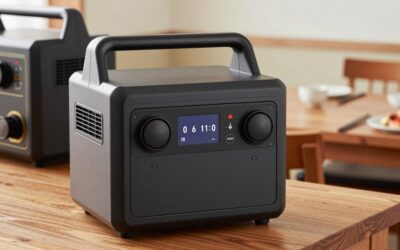
Pellet grill owners: any 1,000W+ inverter or a power station
Pellet grills are the easy case. A 1,000W inverter or a 500Wh+ power station covers the igniter surge, and a 500Wh battery can run the auger and fan for 5-8 hours of low-and-slow cooking.
Tips for better grilling on generator power
Give the grill its own outlet and a heavy cord
A 1,800W grill pulls 15 amps, the full capacity of a standard 120V outlet circuit. Plug it into a 20A-rated outlet on the generator, or into the 30A outlet through a proper adapter, and use a 12-gauge cord no longer than you need. A thin cord drops voltage, which means slower heating and weaker sear marks.
Preheat with the lid closed
The grill lid traps heat, shortening preheat and element on-time. Cooking with the lid down also lets the thermostat cycle the element off, reducing average draw by 20-30% once the grill reaches temperature.
Don’t share the circuit with a cooler or blender
Load spikes from blenders (500-1,000W) or kettles (1,500W) on the same outlet can trip the generator’s breaker mid-cook.
Tailgate and campground considerations
Many campgrounds and stadium lots enforce quiet hours or limits around 60 dBA, and some ban generators outright. Inverter generators in the 3,000W class are generally the quietest way to power an electric grill at an event. Check the venue’s rules first. Chock the wheels, keep fuel in approved cans away from the grill, and never refuel a hot generator.
Keep exhaust away from the food and the crowd
At tailgates, generators end up wedged between vehicles or under canopies, right where people gather. Carbon monoxide collects under awnings and between parked cars. Place the generator well away from canopies, tents, and RVs, at least 20 feet from any occupied structure or camper, with the exhaust facing open space. At home, never run the generator on the balcony or porch where the electric grill lives. That spot is too close to doors and windows.
FAQ
Can a 2,000-watt inverter generator run an electric grill?
It can run a 1,200-1,500W grill. An 1,800W grill will push most 2,000W-class inverters to their continuous limit, so a 3,000W-class unit is the more reliable choice.
Can a portable power station run an electric grill?
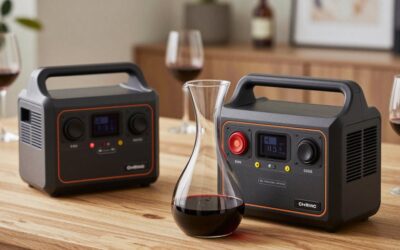
A large station with a 2,000W+ inverter can, but a 1,500-1,800W grill drains a 1,000Wh battery in about 30-40 minutes. For electric grills, a fuel generator or a 2,000Wh+ station is more practical.
Bottom line
An electric grill is a steady 1,500-1,800W resistive load, so choose a generator with at least 1,000W to spare. A 3,000W-class inverter is the sweet spot. Pellet grill owners can go much smaller, even to a battery station.
Write Your Review
No reviews yet. Be the first to share your experience!