
🛒 Best Price Today on Amazon
Prime members get fast, free shipping on everything above, plus member-only deals. New members get a 30-day free trial — cancel anytime.
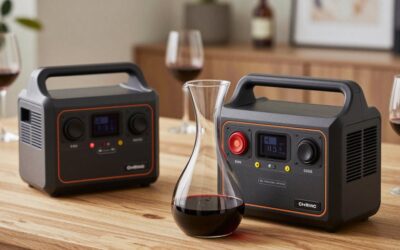
Even a big 5000Wh home-backup battery drains quickly under a space heater. A standard 1,500W heater on high runs for roughly three hours on a 5kWh-class station if it never cycles off, and perhaps five to six hours with typical thermostat cycling. That is not nothing, but it is a poor use of expensive stored energy. The more valuable insight at this size is that a 5kWh station can often run your whole-house heating system for far longer, because a gas furnace or boiler needs only a few hundred watts to operate. This guide compares the options.
Space heater runtime
A 5,000Wh unit provides roughly 4,250Wh of usable AC energy after inverter and reserve losses.
| Heating load | Typical draw | Estimated runtime on ~4,250Wh | What it heats |
|---|---|---|---|
| Space heater on high, nonstop | about 1,500W | about 2.8 hours | one room |
| Space heater, ~50% cycling | about 750W average | about 5.7 hours | one room |
| Gas furnace blower and controls | about 300 to 700W while running | about 12 to 28 hours at ~50% duty | whole house |
| Hot-water boiler circulator and controls | about 80 to 250W while running | about 1.5 to 4 days at ~50% duty | whole house |
| Pellet stove (igniter off after start) | about 100 to 200W running | about 21 to 42 hours nonstop | main living area |
These ranges are typical; your appliance’s nameplate and manual give the real figures. Furnace blowers with ECM (variable-speed) motors are usually at the low end.
Why fuel-fired heating plus a battery works
A furnace burns gas or propane to make heat; electricity only runs the blower, the inducer fan, the igniter and the control board. The battery is therefore moving heat, not making it, which is dramatically more efficient than a resistive heater. The same logic applies to boilers, whose circulator pumps draw even less.
What about a heat pump?
Heat pumps are efficient, often delivering two to three units of heat per unit of electricity, but a whole-home heat pump still draws several kilowatts in cold weather and many are 240V with significant start-up demands. A 5kWh-class station might run one for only a few hours. A mini-split in one room is a more realistic battery load, if the station supports its voltage.
Getting the furnace onto the battery
Furnaces and boilers are hardwired. The right way to connect a station is through a transfer switch, a power inlet with a panel interlock, or the station maker’s dedicated backup panel, installed by a licensed electrician. This isolates the home from the utility while on battery. Never backfeed through an outlet with a double-male cord; it can electrocute line workers and start fires. Some furnaces are sensitive to power quality; nearly all modern home-backup stations deliver pure sine wave output, but check the spec sheet.
Winter battery and CO safety
Keep the station in a heated space. Many lithium stations will not charge, or should not be charged, below freezing unless they have built-in battery heating; charging LiFePO4 cells below about 32°F can cause permanent damage. Capacity also drops in the cold.
Your furnace’s own exhaust venting must be clear of snow and ice; a blocked vent during an outage can push combustion gases indoors. If you recharge the station with a portable generator, run it outdoors at least 20 feet from the house with exhaust aimed away from doors, windows and furnace intakes, never in a garage or on a porch. Keep CO alarms on every level, and never use a grill, camp stove or outdoor heater indoors.
A realistic winter outage plan
- Have an electrician connect the furnace or boiler circuit to the station before winter.
- Lower the thermostat to about 60 to 64°F during the outage to reduce blower run time.
- Close off unused rooms and keep curtains closed at night.
- Reserve some battery for the fridge, lights and phones.
- Use space heaters only briefly, for example to warm a bathroom before a bath.
FAQ
Can I recharge a 5kWh station fast enough to keep a space heater going?
Not realistically with solar in winter. A generator can do it, but then running the heater from the generator via a proper connection is simpler and more efficient.
Will the station handle my furnace blower’s start-up?
Almost always. Blower motors have moderate surges that are well within typical 5kWh-class inverter ratings. Confirm with the station’s current spec sheet.
Bottom line
A 5000Wh-class station runs a 1,500W space heater for only about 3 to 6 hours, but it can often run a gas furnace blower for most of a day or a boiler circulator for several days, heating the entire house. Have a licensed electrician make that connection, keep the battery warm, and verify output and cold-charging limits on the station’s current spec sheet.
Write Your Review
No reviews yet. Be the first to share your experience!