
🛒 Best Price Today on Amazon
Prime members get fast, free shipping on everything above, plus member-only deals. New members get a 30-day free trial — cancel anytime.
A camping generator lives a hard life: bounced around in a truck bed, run at high altitude on a dusty site, and judged by everyone within earshot. The best one for your trips is not the biggest you can afford but the lightest, quietest unit that covers your real loads, fits campground rules, and starts on the first pull after sitting in the garage for three months. This guide goes through the specs that matter for camping specifically, in the order you should weigh them.
1. Figure out your camp load
Start with what you will actually plug in, and separate constant loads from brief high-draw ones.
| Camp appliance | Running watts | Starting watts |
|---|---|---|
| 12V fridge via AC charger | 60–100W | minimal |
| Electric coffee maker | 800–1,200W | minimal |
| Electric griddle or skillet | 1,200–1,500W | minimal |
| Small microwave (700W class) | 1,000–1,200W | minimal |
| Space heater (low setting) | 750W | minimal |
| Trailer AC, 13,500 BTU | 1,300–1,800W | 2,500–3,500W |
| Phone, camera, drone battery chargers | 20–120W | minimal |
For tent and car camping without air conditioning, a generator with 1,600 to 2,200 running watts handles cooking and charging easily. For a trailer with a rooftop AC, look at 3,000W-class inverters or a pair of smaller units in parallel.
2. Noise: the spec your neighbors will notice
Manufacturers usually list noise in dBA measured at 7 meters (23 feet), often at 25 percent load. Small inverter generators commonly fall between 48 and 58 dBA at that distance; open-frame generators often run 65 to 75 dBA. Remember that decibels are logarithmic: a 10 dBA increase sounds roughly twice as loud. Many campgrounds, including many public ones, restrict generators to specific hours and some cap noise around 60 dBA at 50 feet, so an inverter design is effectively required for developed sites.
3. Weight and handling
You will lift the generator in and out of a vehicle every trip. A 2,000W-class inverter typically weighs 40 to 55 lb dry; a 3,000W-class unit often weighs 60 to 100 lb and may have wheels and a telescoping handle. If one person usually loads the gear, stay under about 55 lb or consider two small units instead of one large one.
Parallel capability
Two 2,000W inverters connected with a parallel kit deliver about 3,600 to 4,000W combined. That lets you carry each unit separately, bring only one on short trips, and still start a trailer AC when needed.
4. Fuel type for camp logistics
Gasoline
The default, easy to find near most campgrounds. A small inverter at quarter load typically runs 8 to 12 hours on 1 to 1.2 gallons, so a single 2-gallon can covers a long weekend of modest use.
Propane or dual fuel
Useful if your camp kitchen already runs on propane: one fuel type for stove, heater, and generator. Propane does not spill or go stale, which helps for occasional campers who store the generator for months. Expect 10 to 15 percent less output and higher cylinder consumption.
5. Altitude derating
Generators lose power as altitude rises because the air is thinner. A common rule is around 3 to 4 percent loss per 1,000 feet above sea level. At 7,000 feet, a 2,200W generator may effectively deliver about 1,700 to 1,800W, which can matter for starting a trailer AC. Some models offer high-altitude carburetor jets; check the manual if you camp above 5,000 feet regularly.
| Elevation | Approx. output of a 2,200W generator |
|---|---|
| Sea level | 2,200W |
| 3,000 ft | 1,970–2,000W |
| 5,000 ft | 1,800–1,870W |
| 7,000 ft | 1,650–1,740W |
| 9,000 ft | 1,500–1,600W |
6. Outlets and features for camp use
- A TT-30R outlet if you plug in a travel trailer directly.
- USB ports for charging without an adapter.
- Eco or economy mode to throttle down at light loads, which saves fuel and noise.
- CO detection with automatic shutoff.
- Fuel gauge visible without opening the tank.
- A spark arrestor, required on many public lands.
7. Safety around tents
Carbon monoxide does not care that you are outdoors. Keep the generator at least 20 feet from tents and campers, exhaust pointing away, and never run it under an awning or inside a vestibule. Tents can trap exhaust faster than hard-sided campers. Run a battery CO alarm in any trailer.
FAQ
What size generator do I need for tent camping?
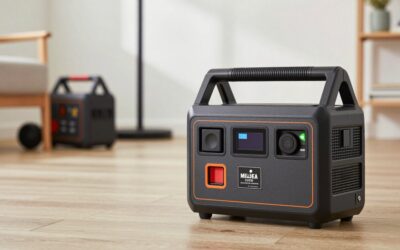
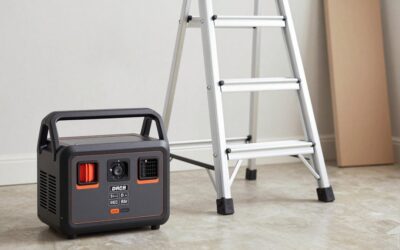
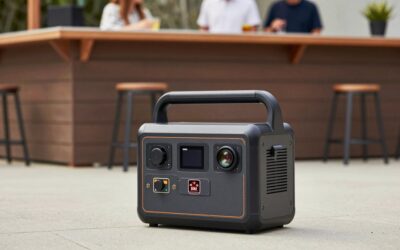
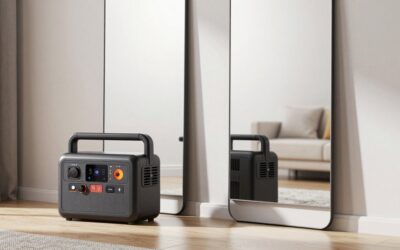
For lights, phone charging, a fan, and an occasional coffee maker, a 1,000 to 2,000W inverter is plenty. If you only need charging and lights, a power station is often a better fit than any generator.
Can I run my generator overnight at a campground?
Usually not. Most developed campgrounds ban generators during quiet hours, often from about 10 p.m. to 6 or 8 a.m. Check each campground’s rules before you go.
Bottom line
For camping, choose a quiet inverter generator between 1,600 and 2,200 running watts for tent and car trips, and a 3,000W-class unit or parallel pair for trailers with air conditioning. Prioritize low dBA, manageable weight, a fuel you already carry, and altitude headroom, and always keep it well away from tents.

Write Your Review
No reviews yet. Be the first to share your experience!