
Our Short List of 3

- Best for: Electronics, battery charging, and quiet light-load running on the inverter side.
- Inverter model
- 2,200 starting watts and 1,800 running watts
- Gasoline powered, GXR120 121cc engine
- Weight: 46.5 pounds

- Best for: Buyers who want inverter quality at the highest output a single enclosed unit here offers.
- Inverter model
- 4,500 starting watts and 3,500 running watts
- Gasoline powered, 212cc engine
- Weight: 101 pounds

- Best for: Mixed loads of electronics and small appliances where clean power still matters.
- Inverter model
- 3,300 starting watts and 2,500 running watts
- Gasoline powered
- Weight: 59.5 pounds
All 4 Picks at a Glance
| Product | Specs | Action |
|---|---|---|
| Honda EU2200i (Inverter) |
| Check price on Amazon |
| Champion 4500-Watt Inverter (Inverter) |
| Check price on Amazon |
| Generac GP3300i (Inverter) |
| Check price on Amazon |
 DuroMax XP10000E (Conventional) |
| Check price on Amazon |
🛒 Best Price Today on Amazon
Prime members get fast, free shipping on everything above, plus member-only deals. New members get a 30-day free trial — cancel anytime.
The choice between an inverter generator and a conventional portable generator is not really about which technology is newer. It is about what you will plug in. Sensitive electronics, battery chargers, and long light-load running favour the inverter. Raw wattage for big tools, pumps, and whole-house backup circuits favours the conventional open-frame machine, which delivers far more output from a simpler engine.
This comparison is for buyers torn between the two camps: campers and tailgaters who value quiet, clean power, and homeowners who need serious watts during outages but also charge phones, laptops, and battery banks. Five representative models are covered below, three inverters and two conventional machines, chosen from their Amazon product names and listed specifications so the trade-offs stay concrete rather than theoretical.
Quick Picks
As an Amazon Associate we earn from qualifying purchases.
| Product | Best for | Key spec from title |
|---|---|---|
| Honda EU2200i (inverter) | Clean power for electronics and battery charging | 2,200 starting watts, 8.1 hours at quarter load |
| Champion 4500-Watt Inverter (inverter) | The largest loads an inverter here can handle | 4,500 starting watts, RV outlet, remote start |
| Generac GP3300i (inverter) | Mid-size inverter loads with flexible outlets | 3,300 starting watts, 30A twistlock and USB ports |
| Generac GP6500 (conventional) | Home backup circuits through a transfer switch | 6,500 running watts, 120/240V output |
| DuroMax XP10000E (conventional) | The heaviest single loads on this page | 8,000 running watts, 120V-only or 120/240V modes |
How to Choose
Decide how clean your power needs to be
Inverter generators convert engine power electronically, producing a smooth sine wave that laptops, phone chargers, modern televisions, and battery power stations accept without complaint. One inverter below lists harmonic distortion under three percent in its family specifications. Conventional generators produce power straight from the alternator, which is fine for motors, heaters, and most tools, but rougher for delicate electronics. List everything you plan to plug in, and let the most sensitive item on that list settle this question. When in doubt, treat chargers as sensitive until their manuals prove otherwise.
Think about noise as a mechanism, not a number
Inverter engines throttle down when the load drops, so at a campsite or during an overnight trickle charge they idle along gently instead of roaring at full speed. A conventional generator must hold a fixed engine speed to maintain frequency, so it sounds much the same powering one light as powering a saw. That difference decides whether neighbours complain and whether you can run the machine at night. Where the generator will sit, and who is within earshot, matters as much as wattage.
Compare fuel use at the load you will really run
Most portable generator hours are light-load hours: a charger, a fridge, a few lights. Inverters shine there, stretching a small tank across a long evening because the engine slows to match demand. Conventional machines burn fuel to hold full speed regardless, which wastes fuel at light loads but makes sense when the load is genuinely large and steady. Estimate your typical running watts honestly, then look at which design wastes less fuel at exactly that level. Two machines with identical tanks can live very different working lives in practice.
Accept the weight and wattage ceiling of each design
Inverters package their electronics in enclosed cases that stay portable, but output tops out lower; the biggest inverter here starts at 4,500 watts. Conventional open-frame machines scale much higher, reaching 8,000 running watts below, at weights up to 210 pounds with exposed frames built for job sites and garage storage. Neither ceiling is a flaw. The mistake is buying inverter portability for a whole-house job, or conventional bulk for a camping trip. Measure the storage space and the lift, not just the spec sheet, before deciding.
The 5 Best Options
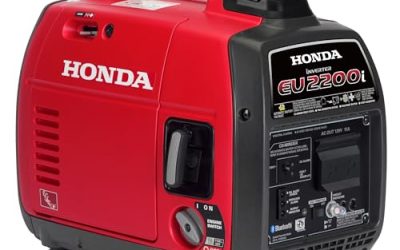
Honda EU2200i (Inverter)
- Best for: Electronics, battery charging, and quiet light-load running on the inverter side.
- Inverter model
- 2,200 starting watts and 1,800 running watts
- Gasoline powered, GXR120 121cc engine
- Weight: 46.5 pounds
Electronics, battery charging, and quiet light-load running on the inverter side.
A single duplex outlet and 1,800 running watts cap what it can ever power.
Representing the inverter side, the Honda shows what the technology does best: modest output delivered cleanly and efficiently. Its 8.1-hour runtime at quarter load suits battery charging and electronics, and the 46.5-pound enclosed case is easy to carry and store. CO-MINDER monitoring is built in. What it cannot do is run big household loads, and that limitation is the whole point of this comparison: the inverter trades ceiling for quality, quiet behaviour, and light-load manners.
Champion 4500-Watt Inverter (Inverter)
- Best for: Buyers who want inverter quality at the highest output a single enclosed unit here offers.
- Inverter model
- 4,500 starting watts and 3,500 running watts
- Gasoline powered, 212cc engine
- Weight: 101 pounds
Buyers who want inverter quality at the highest output a single enclosed unit here offers.
The weight erases much of the portability advantage smaller inverters enjoy.
This Champion stretches the inverter formula toward its ceiling. With 3,500 running watts, an RV outlet, and a wireless remote start, it covers travel trailers and heavier camp setups while keeping inverter power quality and load-following engine behaviour. At 101 pounds it also shows the cost of scaling an inverter up: the case gets heavy, and two smaller paralleled units might suit some buyers better. It is Parallel Ready, with the kit sold separately, and carries CO Shield shutoff protection.
Generac GP3300i (Inverter)
- Best for: Mixed loads of electronics and small appliances where clean power still matters.
- Inverter model
- 3,300 starting watts and 2,500 running watts
- Gasoline powered
- Weight: 59.5 pounds
Mixed loads of electronics and small appliances where clean power still matters.
No runtime figure is listed, so light-load endurance cannot be compared directly here.
The GP3300i is the middle path on the inverter side: 2,500 running watts, a 30A twistlock alongside duplex outlets and USB ports per the brand description, and a CO sensor built in. PowerRush technology is listed for added starting capacity, which helps with motor loads that briefly outdraw a small inverter. At 59.5 pounds it stays movable by one person over short distances. It demonstrates that inverters are not only tiny camping units, even if they still stop well short of conventional output.
Generac GP6500 (Conventional)
On the conventional side, the GP6500 shows why the old design survives: 6,500 running watts with 120/240V output, enough for home backup circuits through a proper transfer switch, plus a 20-foot generator cord in the box. COSENSE carbon monoxide shutoff and PowerRush starting capacity are listed. The trade-offs are equally clear: 172 pounds, an open frame, and an engine that runs at working speed whenever it runs at all. For a house during an outage, those are acceptable terms.
Specs
- Conventional model, model 76722
- 8,125 starting watts and 6,500 running watts
- Gasoline powered
- Weight: 172 pounds
- 120/240V output
- COSENSE carbon monoxide shutoff
- PowerRush technology
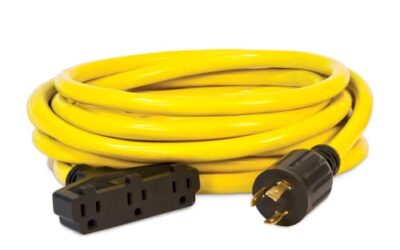
- Includes a 20-foot generator cord
Best for: Home backup and job-site loads that no inverter in this guide can reach.
Watch out for: Fixed-speed running makes it thirstier and louder at light loads than any inverter here.
ASIN: B0CN79QG3C
DuroMax XP10000E (Conventional)
- Best for: The largest loads in this comparison, including heavy tools and whole-panel backup.
- Conventional model
- 10,000 starting watts and 8,000 running watts
- Gasoline powered, 439cc overhead-valve engine
- Weight: 210 pounds
The largest loads in this comparison, including heavy tools and whole-panel backup.
At 210 pounds it is effectively a stationary machine once placed.
The XP10000E is the conventional argument at full volume: 8,000 running watts from a 439cc overhead-valve engine, with MX2 technology that can deliver full power in a 120V-only mode or split across 120/240V at the same time. That flexibility suits big single loads and serious backup panels. It also weighs 210 pounds, which settles where it lives: a garage, a workshop, or a property with a prepared pad, not the back of a car heading to a lake.
Which One Fits Your Situation
Camping, tailgating, and charging batteries
Stay on the inverter side. The Honda EU2200i or Generac GP3300i will charge power stations, run lights and screens, and idle down politely when the load drops. A conventional machine would waste fuel and goodwill in the same setting, and its rougher output is a poor match for chargers and electronics.
Home backup for essentials and circuits
Choose the Generac GP6500. Its 120/240V output and 6,500 running watts can feed selected home circuits through a transfer switch, covering a fridge, furnace blower, well pump, and lights together. No inverter in this guide reaches that territory, and pretending otherwise risks a machine that trips the moment real loads stack up.
Maximum power for tools or a large property
Choose the DuroMax XP10000E. The MX2 system and 8,000 running watts handle heavy single loads and broad backup panels, and the weight matters less when the generator lives in one place. Pair it with a proper transfer switch setup rather than a tangle of extension cords. Fuel planning matters more than portability at this end of the range.
A bit of both worlds across the year
Consider the Champion 4500-Watt Inverter as the compromise, or run two machines for two jobs: a small inverter for trips and charging, a conventional unit for outages. Many owners end up there because the technologies genuinely solve different problems, and one mid-size compromise can leave both jobs half done. That two-machine answer is common for a reason.
Common Mistakes
- Feeding sensitive electronics and battery chargers from a conventional generator without checking their manuals.
- Buying a large conventional generator for camping, then leaving it home because of weight and noise.
- Assuming an inverter can run a whole house because it handles a television so well.
- Comparing only starting watts, when running watts decide what stays on after the first minute.
- Forgetting that conventional generators hold full engine speed even at tiny loads.
Safety Notes
Whichever type you choose, carbon monoxide rules do not change. Run every generator outdoors only, far from doors, windows, and vents, with the exhaust aimed away from any building or tent. Never operate one in a garage, basement, or enclosed porch, and never assume a carbon monoxide sensor or shutoff feature, such as the CO systems listed on several models here, makes an unsafe location acceptable. Let the engine cool fully before refuelling, keep the machine dry and sheltered from rain while it runs, and shut it down before sleeping if it sits anywhere near living space. Connect a home only through a proper transfer switch; backfeeding a panel through an outlet can energise lines and endanger utility workers.
Frequently Asked Questions
Is inverter power really safer for electronics?
Yes, that is the core technical difference. Inverters electronically shape their output into a smooth sine wave, similar in character to household current, which chargers, laptops, and modern electronics are built for. Conventional generators can produce rougher waveforms and voltage swings as loads change. Plenty of sturdy devices tolerate that, but delicate electronics are the reason the inverter category exists.
Why are conventional generators so much more powerful?
Their design is simpler and scales easily: a bigger engine turning an alternator at fixed speed, in an open frame with room to cool. Inverter electronics add cost and complexity as output rises, which is why inverters top out lower while conventional models reach 8,000 running watts and beyond. Each design spends its budget on a different strength.
Which type uses less fuel?
At light loads, the inverter, and it is not close. Its engine slows when demand drops, so a charger or a fridge sips fuel across many hours. A conventional generator holds full speed to maintain frequency, burning similar fuel at small loads as at moderate ones. At sustained heavy loads the gap narrows, because both engines are working hard.
Can a conventional generator charge a portable power station?
Sometimes, but check the power station manual first. Some chargers accept a wide range of input quality, while others reduce charge speed or refuse rough power. If battery charging is a main job rather than an occasional one, that uncertainty is a strong argument for choosing an inverter from the start instead of discovering a limitation during an outage.

Write Your Review
No reviews yet. Be the first to share your experience!