
🛒 Best Price Today on Amazon
Prime members get fast, free shipping on everything above, plus member-only deals. New members get a 30-day free trial — cancel anytime.
When the power goes out, the practical question is not simply whether propane or gasoline is the “better” fuel. It is how long the generator will run, how much fuel you can store, how often you want to refuel, and whether the unit needs to start immediately after sitting for months. A generator that runs longer on paper may be less convenient if its fuel is difficult to store or its tank is too small for an overnight outage.
For most portable generators, gasoline delivers slightly longer runtime from the same-size onboard tank and produces somewhat more power under load. Propane, however, stores better, burns cleaner, and is often easier to keep ready for emergencies. In 2026, many homeowners can also avoid choosing just one: dual-fuel generators let you use gasoline for maximum runtime and propane for long-term storage or cleaner operation.
As an Amazon Associate we earn from qualifying purchases at no extra cost to you.


Quick Verdict
Choose gasoline if runtime, maximum output, and easy refueling are your top priorities. Gasoline is widely available, and a typical 3,000- to 4,500-watt portable generator may run about 8 to 14 hours on a full tank at roughly half load. Actual results vary substantially with the generator, tank size, temperature, and connected appliances.
Choose propane if storage life, low maintenance, and clean startup matter more. Propane does not degrade in the same way gasoline does, so a properly stored cylinder can remain useful for years. Runtime is often 10% to 30% shorter than gasoline at a comparable load, although the difference depends on the engine and fuel system.
A gasoline-only model generally makes sense for short outages and frequent use. A propane or dual-fuel model is usually more attractive for occasional emergency backup, rural homes, and buyers who do not want a can of aging gasoline in the garage.
Side by Side
| Factor | Propane Generator | Gasoline Generator |
|---|---|---|
| Comfort | Less odor and cleaner exhaust; refueling can be slower with small cylinders | Quick to refuel, but fumes and spills are more noticeable |
| Durability | Fuel does not gum up a carburetor during storage; hoses and regulators still need inspection | Reliable when maintained, but stale fuel can clog the carburetor and fuel system |
| Price range | Portable models commonly cost about $300 to $1,500; dual-fuel units often cost $400 to $2,000 | Portable models commonly cost about $250 to $1,300 |
| Maintenance | Usually easier between uses; still requires oil changes, air-filter service, and spark-plug checks | Requires fuel stabilizer or draining before storage, plus normal engine maintenance |
| Space needed | Generator footprint is often about 24 by 18 inches; cylinders need a separate upright storage area | Similar generator footprint, plus approved gasoline cans kept away from ignition sources |
| Look | Often cleaner around the unit because there are fewer fuel spills and odors | Traditional portable-generator appearance; fuel cans can make the setup look more industrial |
| Resale | Dual-fuel models generally appeal to more buyers than propane-only units | Strong demand because gasoline is familiar and widely available |
| Best for | Occasional outages, long storage, clean operation, and backup readiness | Longer runtime per tank, higher output, and easy emergency refueling |
Where Propane Wins
Propane’s biggest advantage is readiness. Gasoline can begin to oxidize and form deposits after several months, especially in a vented or partially filled container. Propane remains stable inside an approved cylinder, so you can keep backup fuel on hand without planning a fuel rotation schedule every few months.
Propane also burns relatively cleanly. It typically leaves fewer carbon deposits and produces less noticeable odor than gasoline, which is useful when the generator is operating near a home—always outdoors and well away from doors, windows, and vents. The fuel also does not spill and evaporate across a garage floor in the same way liquid gasoline can.
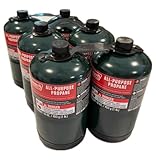
Small propane cylinders are convenient for lightweight inverter generators. For example, a six-pack of Boss Life Outdoors 16-ounce propane cylinders is listed for under $60, while a 12-pack of Coleman 16-ounce cylinders is listed for under $150. These compact bottles are easy to carry, but they are not a practical choice for powering a high-wattage generator through a long outage. At moderate loads, a 16-ounce cylinder may last only a few hours, and heavy loads can reduce that considerably.
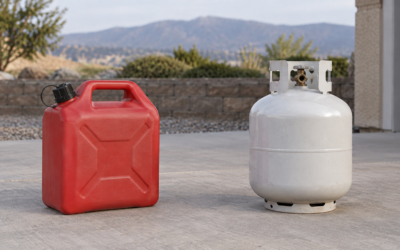
For overnight or multi-day backup, a standard 20-pound grill cylinder is more useful. It holds roughly 4.7 gallons of propane by liquid-volume equivalent, though generators measure consumption differently. Depending on load and engine size, one cylinder may provide approximately 8 to 20 hours of operation. A permanently installed 100- or 250-gallon tank can offer much more reserve, but installation, delivery, and local-code requirements add cost.
Propane can also be a better match for a generator that sits unused most of the year. You still need to run the engine periodically, change oil, inspect the fuel line, and replace worn parts. Propane is not maintenance-free; it simply eliminates many gasoline-storage problems.
Where Gasoline Generator Runtime Wins
Gasoline usually wins the runtime comparison when both generators have similar tank sizes and are powering the same load. Its higher energy density allows a compact onboard tank to deliver strong output for a useful number of hours. A 2,000- to 2,500-watt inverter generator may run about 8 to 12 hours at a light-to-moderate load, while a 4,000- to 4,500-watt portable model may run roughly 8 to 14 hours at half load. These are planning ranges, not guaranteed test results.
Gasoline is also the simpler fuel to find during a regional outage, provided stations have electricity and supplies. It can be poured into a tank quickly, while propane requires a compatible regulator, hose, and cylinder connection. If your generator has a 3.4- to 6-gallon tank, several approved gas cans can extend operation without connecting multiple cylinders.
Portable gasoline inverter models illustrate the range of the market. The Genkins 4500W inverter generator is listed for under $300, while the WEN Super Quiet 2350-watt inverter generator, model 56235i, is listed for under $450. Those prices show why wattage alone is not a reliable value measure: noise control, inverter electronics, emissions equipment, portability, and brand features all affect cost. A smaller, efficient inverter may run longer at a modest load than a larger open-frame unit that is barely working.
Gasoline is the better fit when you need to start demanding equipment such as a sump pump, refrigerator, well pump, or portable air conditioner. Check starting watts, not just running watts. A refrigerator might use only a few hundred running watts but require a short surge of substantially more when its compressor starts.
Cost Over 5 Years
Fuel price is only one part of the five-year cost. For a basic comparison, assume a portable generator runs 100 hours per year, or 500 hours total. A gasoline unit using 0.15 to 0.30 gallon per hour would consume about 75 to 150 gallons over five years. At $3.00 to $4.50 per gallon, fuel would cost approximately $225 to $675.
A comparable propane setup might use about 0.2 to 0.4 gallon-equivalent per hour, requiring roughly 100 to 200 gallons-equivalent over the same period. At an effective cost of about $2.50 to $4.50 per gallon-equivalent, that is approximately $250 to $900. Small disposable cylinders can cost considerably more per unit of energy than refillable 20-pound tanks, so they are best reserved for light loads or compact emergency kits.
Add roughly $50 to $200 over five years for oil, filters, spark plugs, and basic service, depending on usage. Gasoline users may also spend $20 to $60 on approved storage cans and stabilizer. Propane users may spend $30 to $150 on hoses, regulators, and spare cylinders. A typical portable generator itself may cost $250 to $1,500, with dual-fuel models commonly adding about $50 to $300 over comparable gasoline-only units.
In practice, the lowest five-year cost comes from matching the generator to the actual load and avoiding oversized fuel consumption. A 2,300-watt inverter running essential electronics is often more economical than a 7,000-watt open-frame generator running lightly, regardless of fuel type.
Which One for Your Home
Small apartment
Start with a small inverter generator only if you have a legal, safe outdoor location that is well away from the building. Never operate a generator on a balcony, in a hallway, or inside a garage. For apartment dwellers, propane is often easier to store in limited space because it does not spoil, but building rules may restrict cylinder storage. A battery power station may be more practical indoors, while a compact propane generator can work for outdoor use where permitted.
Family with kids or pets
Propane is attractive because there is less risk of liquid fuel spills and lingering gasoline odor. Store cylinders upright, secured against tipping, and outside living areas. Choose a model with at least 3,000 running watts if you need to cover a refrigerator, freezer, lights, internet equipment, and a few small appliances, but calculate starting surges first. Gasoline is preferable if the family needs longer runtime from fewer refueling stops during a severe outage.
Rental
A renter should favor portability, straightforward storage, and no permanent installation. A 2,000- to 3,000-watt inverter generator is easier to move, typically weighing about 40 to 70 pounds, than a larger open-frame model that can exceed 100 pounds. Propane avoids stale-fuel concerns, while gasoline is often easier to replace quickly. Confirm lease, building, and local fire rules before purchasing either fuel type.
Long-term home
Homeowners planning for repeated outages may benefit most from a dual-fuel portable generator or a permanently installed standby system. A dual-fuel portable unit lets you use gasoline when maximum runtime and output are important, then switch to propane for storage and routine readiness. If the home has a well pump, electric heat, medical equipment, or central air conditioning, have an electrician calculate the required starting and running watts before buying.
FAQ
Does propane last longer than gasoline in a generator?
Usually, no. Gasoline commonly provides longer runtime from a comparable tank because it contains more usable energy by volume. Propane’s advantage is storage life and convenience, not normally hours per tank. Actual runtime depends on load, engine efficiency, tank or cylinder size, and weather.
How long will a 20-pound propane tank run a generator?
A 20-pound cylinder may run a portable generator for approximately 8 to 20 hours, depending on wattage and load. A light load on a fuel-efficient inverter can approach the upper end; heavy loads, cold conditions, and frequent surges can reduce runtime sharply.
Is it cheaper to run a generator on propane or gasoline?
There is no universal winner. Gasoline may cost less per hour when sold at ordinary pump prices, while propane can be competitive when purchased in refillable cylinders or from a bulk tank. Disposable 16-ounce bottles generally cost more per unit of energy than larger refillable tanks.
Can a dual-fuel generator run on both fuels at once?
No. A dual-fuel generator is designed to operate on either gasoline or propane, not both simultaneously. Turn the fuel selector off, follow the manufacturer’s changeover procedure, and allow the engine to use or safely purge the current fuel before switching.


Write Your Review
No reviews yet. Be the first to share your experience!