
🛒 Best Price Today on Amazon
Prime members get fast, free shipping on everything above, plus member-only deals. New members get a 30-day free trial — cancel anytime.
Once you’ve decided a portable power station will be part of your home backup plan, the choice between the 2,000Wh and 3,000Wh classes comes down to a few specifics. Do you need 240-volt output? Do you want to run the refrigerator through the night and into the next day without recharging? And can you live with a unit that weighs as much as a large dog? This comparison uses typical class ranges. Specific models vary, so verify the figures on the current spec sheet.
2,000Wh vs 3,000Wh at a glance
| Spec (class range) | 2,000Wh class | 3,000Wh class |
|---|---|---|
| Usable AC energy (~85%) | ~1,700Wh | ~2,550Wh |
| Continuous output | 2,000-3,000W | 3,000-4,000W |
| Surge | 3,500-6,000W | 5,000-8,000W |
| 120/240V capability | Rare, usually via pairing two units | Some natively; many via pairing |
| Weight | 40-60 lb | 60-110 lb (often wheeled) |
| Solar input (max) | 500-1,200W | 1,000-2,400W |
| Home panel integration | Some via transfer switch/hub | Common via transfer switch/hub |
| Typical price | $900-$1,800 | $1,500-$2,800 |
What the extra 1,000Wh buys you
A full outage day on essentials
A realistic essentials load of refrigerator (~60W average), router and modem (~20W), LED lights (~30W in the evening), and phone and laptop charging (~30W) averages about 120-150W. That’s around 3-3.5 kWh per day. A 2,000Wh class unit covers roughly half a day. A 3,000Wh unit gets you through a full evening and night into the next morning, when solar or a generator can take over. That’s often the difference between getting through an overnight outage and needing to recharge in the dark.
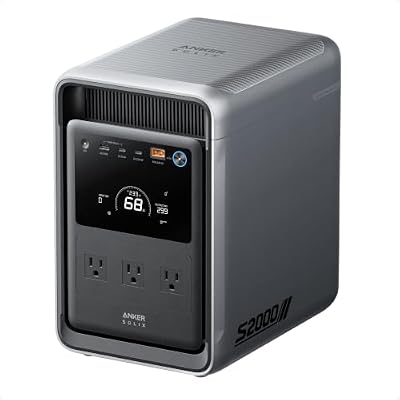
Anker SOLIX S2000 Portable Power Station, 2,010Wh, 1,500W
Included for '2000Wh vs 3000Wh Power Station: Which Size Do You Need?' because the listing specifies 010Wh and 500W, details this guide uses to compare options.
View on Amazon
Anker SOLIX C300 Portable Power Station, 288Wh Solar Generator for Camping
Included for '2000Wh vs 3000Wh Power Station: Which Size Do You Need?' because the listing specifies 288Wh Solar Generator for Camping, details this guide uses to compare options.
View on Amazon
Anker SOLIX F3000 Portable Power Station, 3,072Wh, 6,000W, Solar Generators
Included for '2000Wh vs 3000Wh Power Station: Which Size Do You Need?' because the listing specifies 072Wh and 000W, details this guide uses to compare options.
View on AmazonMore headroom for motor loads
The higher continuous and surge ratings of the 3,000Wh class make it more comfortable with a sump pump (800-1,500W surge), a 1/2 HP well pump on 120V, or a window AC unit, often with other loads still running.
The 240-volt question
Many homes need 240V for a well pump, a central AC air handler, or a dryer. Most 2,000Wh-class stations output only 120V. In the 3,000Wh class, some units offer split-phase 120/240V natively, and several platforms let you pair two units for 240V. If a 240V appliance is on your list, confirm native 240V support or a pairing kit before you buy. Any connection to your home panel must go through a transfer switch or manufacturer home hub installed by a licensed electrician. Never backfeed a dryer outlet.
Portability reality check
A 2,000Wh station at 40-60 lb can still be lifted into a car by one person. Many 3,000Wh stations cross 70-100 lb and ride on wheels and a telescoping handle. They’re fine for rolling from a garage to the kitchen, but not for stairs or a truck bed without help. If the station will double as a camping or RV power source, the lighter class has a real advantage.
Solar recharging math
With 800W of panels in good sun, typically 4-5 peak sun hours, you can harvest roughly 2.5-3.5 kWh a day after losses. That nearly refills a 3,000Wh unit and fully refills a 2,000Wh unit. If you’re planning solar-only resilience for multi-day outages, the larger battery pairs better with a bigger array, and most 3,000Wh-class stations accept higher solar wattage.
Noise, heat, and fan behavior
Power stations are called silent, but their cooling fans spin up under heavy loads and fast charging. A 2,000Wh unit running a 1,500W microwave or charging at full AC speed can reach 45-55 dBA at a meter. The 3,000Wh class, with more thermal mass and larger fans, often runs quieter at the same load because it’s working a smaller fraction of its capacity. If the unit will sit in a bedroom powering a CPAP or fan overnight, check reviews for fan noise at low loads. Some models idle their fans completely below about 100-200W, which makes a real difference to sleep.
Battery longevity and care
Both classes now mostly use LiFePO4 chemistry rated at 3,000-4,000 cycles. Keep them in a climate-controlled space: charging below freezing damages LiFePO4 unless the unit self-heats, and sustained heat above about 95-104°F accelerates aging. For storage, park at 50-60% and check every few months. A power station produces no carbon monoxide, but if you recharge it from a fuel generator during an outage, that generator must run outside, at least 20 feet from the house, and the home needs working CO alarms.
FAQ
Is a 3,000Wh power station enough for a whole house?
No. It covers essential circuits for about a day: fridge, lights, internet, and a few small appliances. Whole-house backup with central AC or electric heat requires much larger battery systems or a standby generator.
Can I add batteries later instead of buying 3,000Wh now?
Many 2,000Wh-class platforms accept expansion batteries, often adding 2,000Wh or more each. That’s a sensible path, but the inverter stays the same, so check that the base unit’s output meets your needs.
Bottom line
The 2,000Wh class suits portable, half-day backup of core essentials. The 3,000Wh class earns its extra weight and cost with overnight coverage, stronger motor starting, and more frequent 240V options. Pick based on your longest likely outage and whether you need 240V.

Write Your Review
No reviews yet. Be the first to share your experience!