
🛒 Best Price Today on Amazon
Prime members get fast, free shipping on everything above, plus member-only deals. New members get a 30-day free trial — cancel anytime.
- Decide These 3 Things First
- Size: Match Running and Starting Watts
- Material and Fuel-System Details
- Construction: Portability, Protection, and Service Access
- Comfort and Performance: Noise, Runtime, and Power Quality
- Price Tiers: What Your Budget Buys
- Warranty and Long-Term Support
- Delivery and Assembly
- Spec Checklist
- Red Flags
- FAQ
Shopping for a generator by the largest wattage number is one of the most common mistakes buyers make. A 4,300-watt model may look like a bargain until you discover that its starting surge cannot handle your refrigerator and sump pump together. Another frequent error is treating a manufacturer’s “runtime” claim as a fixed promise. Runtime changes with load, fuel type, tank size, altitude, temperature, and maintenance.
The better question is not simply what to look for generator runtime, but what combination of usable power, fuel capacity, efficiency, portability, and safety will fit your situation. A compact inverter generator may run quietly for a weekend of camping, while a larger open-frame unit may be the more practical choice for emergency home backup. The following guide explains the specifications that matter most in 2026, with realistic price and performance ranges rather than a single headline number.
As an Amazon Associate we earn from qualifying purchases at no extra cost to you. Product prices and availability are accurate as of the date shown and are subject to change.

Decide These 3 Things First
- What will you power? List each appliance’s running watts and starting watts. A refrigerator might use approximately 100 to 800 running watts but require 1,200 to 2,000 starting watts, depending on its compressor. A 1,000-watt space heater uses about 1,000 watts continuously.
- How long must it run between refuels? For occasional camping, six to eight hours at a moderate load may be enough. For overnight outages, look for 10 to 14 hours at 25% load or a model that accepts an extended-run fuel setup approved by its manufacturer.
- Where will you operate it? Inverter generators are generally better suited to campsites and neighborhoods because they are quieter and produce cleaner power for sensitive electronics. Larger conventional generators can offer more output for less money, but they are heavier and often louder.
Size: Match Running and Starting Watts
Generator sizing begins with two numbers: rated watts, which the unit can provide continuously, and surge or starting watts, which it can supply briefly when motors start. Add the running watts of devices you expect to use at the same time, then add the largest starting-watt difference among motor-driven appliances. A 20% to 25% capacity cushion is sensible.
For basic camping, phone charging, lights, a small fan, and a cooler, a 1,800- to 2,500-watt inverter generator is usually a practical range. For a refrigerator, lights, internet equipment, and a few small appliances, consider 3,000 to 4,500 starting watts and at least 2,500 to 3,500 rated watts. Central air-conditioning, electric water heaters, well pumps, and electric ranges typically require a much larger generator and professional electrical planning.
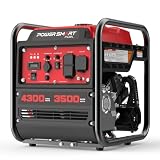
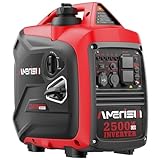
Do not confuse a 4,300-watt peak figure with 4,300 watts of continuous output. A portable product advertised around 4,300 peak watts may provide roughly 3,500 to 3,600 rated watts. Compact 2,500-watt models commonly deliver about 1,900 to 2,200 rated watts. Confirm the exact rating on the specification label before buying.
Material and Fuel-System Details
Most portable generators use a steel frame with a plastic or steel fuel tank and an aluminum engine housing. A steel frame can better tolerate loading and transport, but it adds weight. Plastic body panels resist surface rust and help reduce weight, though they do not make a generator weatherproof.
For gasoline models, tank capacity is a major runtime clue. A 1.1- to 1.5-gallon tank is common on compact inverter generators; larger portable units may hold 3 to 5 gallons. Tank size alone does not determine efficiency, however. A smaller inverter unit operating at 25% load may outlast a less efficient open-frame generator with a larger tank.
Look for an automatic low-oil shutdown, an accessible fuel shutoff, and a fuel gauge or clear level indicator. A 120-volt model is sufficient for many household and camping loads. A 120/240-volt selector and a 30-amp or 50-amp outlet become important for certain transfer-switch installations, but they do not automatically make a generator suitable for whole-home backup.
Construction: Portability, Protection, and Service Access
Weight and dimensions affect whether you will actually use the generator. Small suitcase-style inverter generators often measure about 19 to 24 inches long, 12 to 15 inches wide, and 17 to 20 inches high, with weights of approximately 40 to 60 pounds. A 3,500- to 4,300-watt portable unit may measure 24 to 28 inches long and weigh 75 to 110 pounds.
Wheels and a folding handle are worthwhile once a generator exceeds about 70 pounds. Check wheel diameter, handle clearance, and whether the handle locks in both the folded and extended positions. A protective frame can shield the controls, but it should not block access to the oil drain, spark plug, air filter, or fuel cap.
Choose a generator with a covered or well-recessed control panel, rubber feet, and firm outlet covers. These details help during transport and reduce damage from dirt and moisture. No portable generator should be operated in rain unless the manufacturer specifically provides an approved protection system; never place one in a garage, shed, basement, or other enclosed area.
Comfort and Performance: Noise, Runtime, and Power Quality
Noise is measured in decibels, usually at a stated distance and load. Many inverter generators list approximately 52 to 60 dBA at 25% load, while open-frame portable units may be around 65 to 75 dBA under comparable conditions. Because sound ratings are not always measured the same way, treat them as useful comparisons, not lab-equivalent guarantees.
Inverter technology allows the engine to slow down when demand falls. That can reduce fuel consumption and noise while providing stable output for laptops, televisions, chargers, and other electronics. A conventional generator may be perfectly suitable for tools, lights, and appliances, but confirm whether the manufacturer specifies low total harmonic distortion when sensitive electronics are part of your plan.
Runtime claims should always include the load percentage. A generator advertised for 10 hours may achieve that figure at 25% load, not at its maximum output. As a general buying benchmark, look for at least 6 to 8 hours at 50% load in a compact unit, or 10 to 14 hours at 25% load in a larger fuel-efficient model. Eco mode, altitude, cold weather, and the condition of the air filter can all change actual runtime. Never connect two generators in parallel unless both are designed for it and you have the correct parallel kit.
Price Tiers: What Your Budget Buys
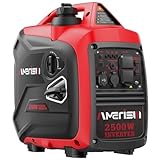
Budget, $250 to $350: Expect compact 2,000- to 2,500-watt inverter generators or basic 4,000- to 4,300-watt open-frame models. Typical compromises include louder operation, shorter warranty coverage, fewer outlets, smaller fuel tanks, and less polished controls. Products such as entry-level PowerSmart and AMERISUN models may fall in this general pricing territory, though prices change by retailer and promotion.
Midrange, $350 to $700: This tier commonly adds better noise control, stronger frames, electric start on some larger models, improved displays, CO detection, and longer stated runtime. You may also find parallel capability and a 30-amp RV-ready outlet. Verify that the advertised wattage is rated output rather than peak output.
Premium, $700 and above: Premium portable generators generally offer more refined inverter systems, larger fuel capacity, robust service support, better weather protection around controls, and more comprehensive safety features. They are worth considering for frequent outages or regular recreational use, but a high price does not eliminate the need for safe placement and proper load management.
Warranty and Long-Term Support
A one-year limited warranty is common at the budget end; two to three years is more reassuring for residential use. Some warranties separate residential and commercial coverage, offering a shorter period for job-site use. Read whether labor, parts, shipping, and diagnosis are included, and check the requirements for registering the product.
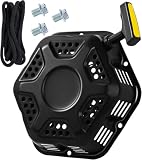
Parts availability matters as much as the warranty headline. Confirm that air filters, spark plugs, carburetor components, wheels, control modules, and recoil assemblies can be purchased separately. A generator that uses a common engine size may be easier to maintain than one with proprietary components. Keep receipts, record the first oil change, and follow the manual’s storage procedure before seasonal downtime.
Delivery and Assembly
Small inverter generators may arrive nearly ready to use, but buyers commonly need to add engine oil, install a handle, attach wheels, or connect a battery. Larger units can weigh more than 100 pounds and may require two adults or a loading ramp. Before ordering, measure doors, steps, storage shelves, and the location where you will refuel.
Inspect the carton for crushed corners and photograph damage before opening. Check that the wattage label, serial number, CO sensor, outlets, tools, manual, and oil-filling equipment are present. Never run a new generator without adding the specified oil, and do not assume the included oil is enough for a complete fill.
Spec Checklist
| Spec | Budget | Mid | Premium |
|---|---|---|---|
| Typical price | $250–$350 | $350–$700 | $700–$1,500+ |
| Rated output | 1,800–3,500 watts | 2,500–5,000 watts | 3,000–7,000+ watts |
| Fuel tank | 1.1–3 gallons | 2–5 gallons | 3–8 gallons |
| Runtime target | 6–10 hours at 25% load | 8–14 hours at 25% load | 10–18 hours at 25% load |
| Approximate weight | 40–90 pounds | 60–120 pounds | 80–180 pounds |
| Noise target | 52–75 dBA | 50–70 dBA | 48–65 dBA |
| Warranty target | 1 year | 2 years | 2–5 years |
Red Flags
- A runtime claim that does not state the load percentage.
- Only a peak-watt number, with no clearly labeled rated output.
- No CO sensor or no clear instructions for outdoor placement.
- A noise rating without a measurement distance or operating load.
- Reviews mentioning fuel leaks, difficult starting, overheating, or unavailable parts.
- A suspiciously low price paired with no visible warranty, manual, serial number, or customer-service information.
- Instructions that recommend indoor operation, operation in wet conditions, or unsafe backfeeding through a wall outlet.
FAQ
What does generator runtime actually mean?
Runtime is the approximate number of hours a generator can operate on one tank under stated conditions. It is usually measured at 25% load, so actual runtime will be shorter when you use more of the generator’s rated capacity.
Is a 2,500-watt generator enough for a home outage?
It can run essentials such as lights, a refrigerator, a modem, chargers, and a small fan if their combined starting and running watts stay within the generator’s limits. It will not typically run central air-conditioning, electric heating, or several large appliances at once.
Are inverter generators worth the extra cost?
They are often worth considering when low noise, fuel efficiency, portability, and electronics-friendly output matter. A conventional generator may be the better value for high-wattage tools or occasional emergency use where noise and weight are less important.
Can I leave a generator running overnight?
Only if it is outdoors, well away from doors, windows, and vents, on a stable dry surface, and operated exactly as directed. Install working carbon-monoxide alarms in the home, keep fuel away from ignition sources, and refuel only after the engine has cooled.
Ready to decide? Our #1 pick for 2026 is the Typical price.
Live price & availability on Amazon.



Write Your Review
No reviews yet. Be the first to share your experience!