
🛒 Best Price Today on Amazon
Prime members get fast, free shipping on everything above, plus member-only deals. New members get a 30-day free trial — cancel anytime.
Sizing a generator for a box fan is almost the opposite problem from sizing one for a well pump. The fan needs so little power that almost any generator will run it, which means the real questions are efficiency, noise, fuel burn and whether a generator is even the right tool. For a hot night without power, the answer often looks different from what people expect.
The technical minimum is tiny
A 20-inch box fan draws roughly 40 to 100 watts with a negligible starting spike. The smallest inverter generators, rated around 1,000 watts, could run ten of them. So the generator decision is really about what else you want powered, and how efficiently the generator runs at very light load.
Why oversizing hurts here
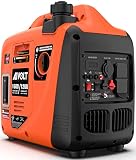
A conventional open-frame generator runs at a fixed 3,600 rpm no matter the load. A 5,000-watt unit feeding one box fan still burns roughly 0.35 to 0.5 gallons of gasoline per hour, the same as it would with a much larger load. An inverter generator with eco mode throttles down to match the load, and a 2,000-watt inverter feeding a fan and a few lights can drop to roughly 0.1 gallons per hour or less. For fan-only duty, oversizing wastes fuel and makes noise all night.
| Power source | Fan load | Approx. consumption | Approx. runtime | Noise near the house |
|---|---|---|---|---|
| 1,000 – 1,200 W inverter, eco on | 1 fan, 75 W | 0.06 – 0.1 gal/h | 6 – 9 h per 0.6 gal tank | quiet, 50 – 55 dB |
| 2,000 – 2,500 W inverter, eco on | 2 fans + lights, 200 W | 0.08 – 0.12 gal/h | 8 – 12 h per 1 gal tank | quiet, 52 – 58 dB |
| 5,000 W open-frame | 1 fan, 75 W | 0.35 – 0.5 gal/h | 9 – 12 h per 4 – 5 gal tank | loud, 68 – 74 dB |
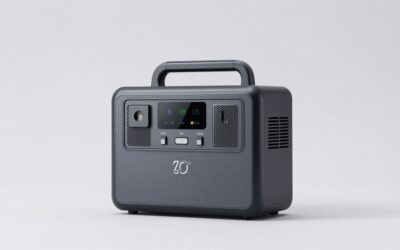
| Power station, 500 Wh | 1 fan, 75 W | no fuel | about 5 – 6 h | silent |
| Power station, 1,000 Wh | 1 fan, 50 W (low) | no fuel | about 16 – 17 h | silent |
Figures are typical ranges, not ratings for any specific model; check the current spec sheet for fuel consumption at 25 percent load and battery capacity.
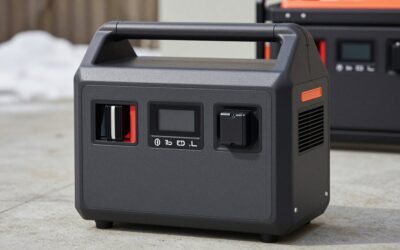
Power stations often win for fan-only duty
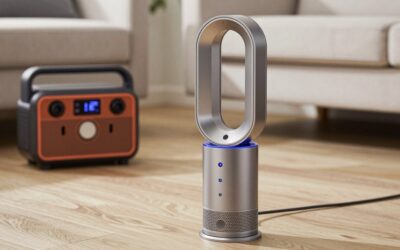
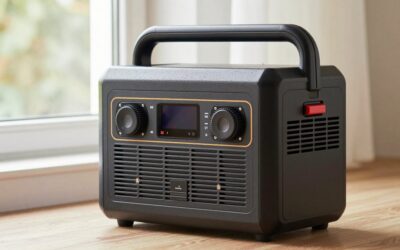
For overnight cooling, a portable power station is frequently the better tool. It is silent, produces no exhaust, and can sit right next to the bed. The runtime math is simple: take the battery capacity in watt-hours, multiply by roughly 0.85 to account for inverter losses, then divide by the fan’s wattage. A 1,000 Wh station running a 50-watt fan on low gives about 17 hours. If the station has DC outputs and you use a 12-volt DC fan, you skip inverter losses entirely and the runtime stretches another 10 to 15 percent.
Recharging during the day
If the outage lasts several days, the station needs refilling. Solar panels of 200 to 400 watts can replace 1 to 2 kWh on a sunny day. Alternatively, run a small inverter generator for a couple of hours in the afternoon to recharge the station, then shut it off at night. This hybrid approach cuts fuel use and eliminates overnight engine noise.
When the fan is just one load among many
In most real outages the fan is joined by a refrigerator, phone chargers, maybe a CPAP and a few LED lights. That combination typically totals 300 to 800 running watts with a fridge compressor surge of 1,000 to 1,500 watts. A 2,000 to 3,000 watt inverter handles it comfortably. The fans are rounding error; the refrigerator decides the size.
Safety when running a generator for sleep
Running a generator overnight while people sleep is the scenario that produces the most carbon monoxide injuries. Keep it at least 20 feet from the house, exhaust pointed away from doors and windows, and never in a garage even with the door open. Put battery-powered CO alarms in bedrooms. If you are placing a fan in a window to pull in night air, make sure the generator is nowhere near that window or on the upwind side of it.
FAQ
Can a car inverter run a box fan?
A 300 to 400 watt inverter plugged into a 12-volt socket or clamped to the battery will run a box fan. Idling a car for hours is inefficient and has its own CO risks, so use this only briefly.
Will a modified sine wave inverter damage a box fan?
Probably not, but AC fan motors often hum louder and run warmer on modified sine wave power. Pure sine wave sources, including inverter generators and most power stations, avoid the issue.
Bottom line
Any generator will run a box fan, but a 1,000 to 2,000 watt inverter with eco mode is the efficient choice if a generator is required. For fan-only overnight cooling, a 500 to 1,000 Wh power station is quieter, safer and often cheaper to operate. Size up only when the fridge and other essentials join the load.

Write Your Review
No reviews yet. Be the first to share your experience!