
🛒 Best Price Today on Amazon
Prime members get fast, free shipping on everything above, plus member-only deals. New members get a 30-day free trial — cancel anytime.
A power station is only as useful as your ability to refill it. Wall charging can be fast, solar depends on weather, and car charging is almost always slower than people expect. Knowing realistic charging times lets you plan outages and trips properly instead of discovering the limits in the middle of one. This guide explains the simple math behind charging time, compares the three main sources, and gives estimates for common station sizes.
The basic formula
Charging time in hours roughly equals the energy to add in watt-hours divided by the effective charging watts. Effective watts are lower than the input rating because of conversion losses, typically 5 to 15 percent, and because charging slows as the battery approaches full.

Jackery Explorer 1000 v2 Portable Power Station,1070Wh,1500W
Included for 'Portable Power Station Charging Times Compared: AC, Solar, and Car' because the listing specifies 1070Wh and 1500W, details this guide uses to compare options.
View on Amazon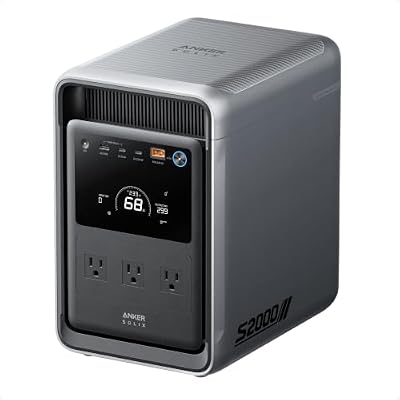
Anker SOLIX S2000 Portable Power Station, 2,010Wh, 1,500W
Included for 'Portable Power Station Charging Times Compared: AC, Solar, and Car' because the listing specifies 010Wh and 500W, details this guide uses to compare options.
View on Amazon
BLUETTI Portable Power Station AC180, 1152Wh LiFePO4 Battery Backup w/ 2 1800W (2700W peak) AC Outlets, 0-80% in 45Min, Solar Generator for Camping, Off-grid, Power Outage
Included for 'Portable Power Station Charging Times Compared: AC, Solar, and Car' because the listing specifies 0-80% in 45Min and Solar Generator for Camping, details this guide uses to compare options.
View on Amazon
Anker SOLIX C1000 Gen 2 Portable Power Station
Included for 'Portable Power Station Charging Times Compared: AC, Solar, and Car' as a relevant option in this category; details come from the product listing.
View on AmazonA quick example
A 1,000Wh station charging from empty at 800 effective watts needs about 1.25 hours in theory, plus some extra time for tapering near full, so roughly 1.3 to 1.5 hours.
Charging times by source and capacity
Estimates assume typical rates and include modest losses and tapering.
| Station capacity | Fast AC (~1,000-1,800W) | Standard AC (~400-600W) | Solar 400W array (~280W real) | Car 12V (~100-120W) |
|---|---|---|---|---|
| 300Wh | ~0.5 hour | ~0.7-1 hour | ~1.2 hours of peak sun | ~3 hours |
| 1,000Wh | ~1-1.2 hours | ~2-2.7 hours | ~3.8 hours of peak sun | ~9-10 hours |
| 2,000Wh | ~1.5-2 hours | ~4-5.5 hours | ~7.5 hours of peak sun | ~18-20 hours |
| 3,600Wh | ~2-3 hours | ~7-9 hours | ~13.5 hours of peak sun | ~33-36 hours |
Car charging is clearly a top-off method, not a primary recharging source for larger stations.
AC charging: fast but grid-dependent
Many modern stations charge from a wall outlet at 1,000W or more, filling a 1kWh unit in about an hour. Fast charging is valuable when power returns briefly between outages or before a forecast storm. For routine charging, slower modes produce less heat and fan noise and may slightly extend battery life.
Generator charging
A small inverter generator can charge a station through its AC input. A 2,000W-class inverter easily supplies a 1,200W charge rate, recharging a 1kWh station in roughly an hour while using a fraction of a gallon of fuel.
Solar charging: weather decides
Solar charging depends on panel wattage, peak sun hours, panel angle, temperature, and the station’s solar input limits. Portable panels typically deliver 60 to 80 percent of rated output in good conditions. A 400W array might produce about 280W at midday, and total daily energy depends on peak sun hours, commonly 3 to 6 per day depending on season and location.
Daily solar harvest
A 400W array in 5 peak-sun hours at about 70 percent real-world efficiency harvests about 1.4kWh, enough to refill a 1kWh station with room to spare. On a cloudy day, the same array might produce only 20 to 40 percent of that.
Car charging: slow and steady
A standard 12V car socket is usually fused at 10 to 15A, limiting charging to about 100 to 150W. That is fine for small stations and for topping up while driving, but it takes many hours to refill 1kWh or more. Some vehicles support faster charging through dedicated alternator chargers, which can supply 300 to 800W with a proper installation.
Do not idle for hours
Idling a vehicle to charge a power station is inefficient and, in enclosed or semi-enclosed spaces, dangerous due to carbon monoxide. Charge while driving, not while parked in a garage.
Combining sources
Many stations accept AC and solar simultaneously, or solar and car together, adding charging rates within the unit’s total input limit. Dual charging can cut solar-only charging times substantially. On a road trip, for example, 120W from the car socket while driving plus 200W of panels at a lunch stop can add around 600 to 700Wh over a day, enough to keep a 1kWh station running a 12V fridge indefinitely.
FAQ
What is the fastest way to charge a portable power station?
Fast AC charging from a wall outlet or inverter generator is typically fastest. Combining AC and solar, if supported, can be faster still.
Can I charge my power station from my car overnight?
Not with the engine off; it can drain the car’s starting battery. Charge while driving, and never idle the car in an enclosed space.
Bottom line
AC charging refills most stations in one to three hours, solar depends on panel size and sun, and car charging is best for topping up. Plan your outage and travel setups around realistic charging rates, and use solar or a generator to extend runtime during long outages.


Write Your Review
No reviews yet. Be the first to share your experience!