
🛒 Best Price Today on Amazon
Prime members get fast, free shipping on everything above, plus member-only deals. New members get a 30-day free trial — cancel anytime.
Boondocking means no hookups: no shore power, no campground pedestal, just your RV parked on public land for days at a time. Most rigs come with a small lead-acid house battery that tops out after a night of lights and the furnace fan. A lithium power station, or a pair of them, is the easiest way to add serious capacity without rewiring the coach, and it keeps the onboard generator off during quiet hours.
Why a lithium power station suits RV boondocking
The RV’s own converter and house battery were designed for short stays, not four nights in the desert. A portable LiFePO4 station can run the 120V loads directly, charge from rooftop or portable solar, and move between rigs or into a tent when you park. Many boondockers use one as a dedicated power hub for the fridge inverter, CPAP and electronics while the house battery handles 12V lights and water pump.

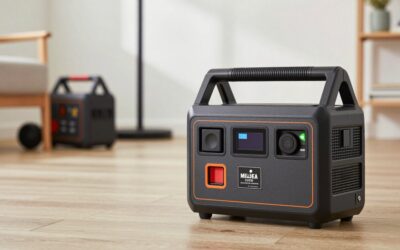
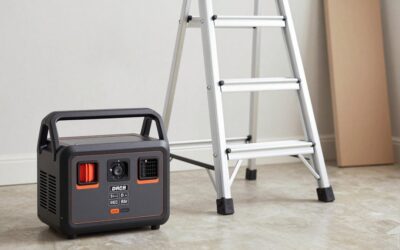
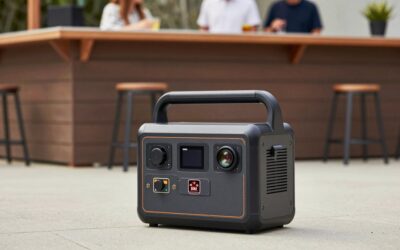
Portable Power Station 3600Wh PowerMax 3600 SE, 2.4H Fast Charge
Included for 'Best Lithium Power Station for RV Boondocking in 2026' because the listing specifies 2.4H Fast Charge, details this guide uses to compare options.
View on AmazonAlmost every serious station sold today uses lithium iron phosphate (LiFePO4) cells rather than the older NMC chemistry found in laptops and early power banks. The practical difference is lifespan and safety: LiFePO4 packs are commonly rated for roughly 3,000-4,000 full cycles before dropping to 80% of original capacity, versus about 500-1,000 cycles for NMC, and the chemistry is far more resistant to thermal runaway. The trade-off is weight, since LiFePO4 stores less energy per pound, so a 2kWh-class unit usually lands somewhere in the 40-60 lb range.
Sizing the battery for RV boondocking
Plan for the whole stay minus what solar can realistically replace each day. In the desert that may be most of it; under trees it may be very little. The table below is a realistic daily load profile; swap in the nameplate numbers from your own gear.
| Load | Typical draw | Hours per day | Energy used |
|---|---|---|---|
| Residential fridge (average) | 110W | 24 h | 2,640Wh |
| Furnace blower fan | 60W | 5 h | 300Wh |
| Water pump (intermittent) | 60W | 0.5 h | 30Wh |
| LED interior lights | 25W | 5 h | 125Wh |
| Laptop and phones | 70W | 4 h | 280Wh |
| Satellite internet dish | 60W | 8 h | 480Wh |
| Daily total | 385W if all on at once | – | 3,855Wh |
That profile uses about 3,855Wh per day. Divide by 0.85 to account for inverter losses and add 20% so you are not draining the pack to zero every day, and you land near 5,442Wh of rated capacity. In practice that points to a station in the 6,000Wh class or larger. On the output side, the inverter must cover whatever runs at the same moment; if everything above were switched on together it would draw about 385W, although real use is rarely that stacked. A residential fridge compressor and a microwave are the big surge items. If you want to run a 1,000W microwave for a few minutes you need an inverter of 1,800W continuous or more.
Quick capacity reference
| Capacity class | Usable energy (about 85%) | Typical weight | Runs a 100W load for |
|---|---|---|---|
| 500Wh | ~425Wh | 13-18 lb | ~4 h |
| 1,000Wh | ~850Wh | 22-30 lb | ~8.5 h |
| 2,000Wh | ~1,700Wh | 40-60 lb | ~17 h |
| 3,000-4,000Wh | ~2,550-3,400Wh | 70-110 lb | ~25-34 h |
Features that matter most for RV boondocking
High solar input
For multi-day stays, solar input capacity is the most important spec. A station that accepts 800-1,600W of panels can refill a 2kWh pack in a good day; one limited to 200W never will.
Pass-through and UPS
Running the RV’s 120V circuit from the station via its inlet means the station charges and supplies loads at the same time. A fast switchover helps when you swap between the station and the onboard generator.
Cold-weather behaviour
High-desert nights fall below freezing. Self-heating battery packs or keeping the station inside the heated coach protect it from the low-temperature charging cut-off.
Recharging plan
Many rigs combine roof panels, a portable ground panel you can aim, and the alternator while driving. A 2kWh-class station plus 600-800W of solar in the Southwest can run a residential fridge indefinitely; add a quiet inverter generator for cloudy stretches.
For solar, a useful rule is panel watts x peak sun hours x 0.75 (a real-world derate for heat, angle and cloud). To replace 3,855Wh a day with about 5.5 peak sun hours you would need roughly 935W of panels. If that array is larger than you can carry or mount, plan on topping up from wall power, the vehicle alternator, or a small fuel generator on the worst days.
Common mistakes to avoid
- Running an electric space heater on battery. A 1,500W heater drains 2kWh in about 80 minutes; use the propane furnace instead.
- Mounting roof panels flat in winter when the sun sits low, which can cut output by a third.
- Forgetting that a residential fridge uses two to three times the energy of a propane absorption fridge on battery.
FAQ
Can a lithium power station run an RV air conditioner?
A 13,500 BTU rooftop unit draws roughly 1,200-1,600W running with a big start-up spike. Large 3-4kWh stations with 3,000W+ inverters and a soft-start kit can run one for two to three hours, which is fine for an evening cool-down but not overnight.
How many days can I boondock on a 2kWh station?
Without a residential fridge, typical usage is 600-900Wh a day, so two to three days without sun. With 400W+ of solar in good weather, you can stay much longer.
Bottom line
For boondocking, pick a LiFePO4 station in the 2-4kWh class with high solar input, reliable pass-through and cold-weather protection. Size the panels as carefully as the battery, and keep the propane furnace and fridge on gas where possible to stretch every stored watt-hour.



Write Your Review
No reviews yet. Be the first to share your experience!