
🛒 Best Price Today on Amazon
Prime members get fast, free shipping on everything above, plus member-only deals. New members get a 30-day free trial — cancel anytime.
Boondocking, camping without hookups on public land or in remote spots, is where RV power planning gets serious. Without shore power, every amp-hour comes from your batteries, your solar, or a generator. Stays commonly run a week or two, and the loads are bigger than tent camping: a residential fridge, water pump, furnace fan, and sometimes a rooftop air conditioner. This article compares a generator-centered setup with a power-station or lithium-battery-centered one for extended off-grid RV stays.
Daily energy use for a boondocking RV
| RV load | Running watts | Daily energy (approx.) |
|---|---|---|
| 12V compressor fridge | 40–70W cycling | 0.6–1.2 kWh |
| Residential fridge via inverter | 100–200W cycling | 1.2–2.5 kWh |
| Water pump (intermittent) | 60–100W | 0.05–0.15 kWh |
| Furnace blower (cold nights) | 30–70W at 12V | 0.3–0.8 kWh |
| Lights, fans, electronics | 50–150W | 0.3–1.0 kWh |
| Laptop and remote work gear | 60–120W | 0.4–1.0 kWh |
| Rooftop AC, 13,500–15,000 BTU | 1,300–1,800W | 6–12 kWh (5–7 h) |
| Microwave or induction cooking | 1,000–1,800W | 0.2–0.6 kWh |
Without air conditioning, most rigs use 1.5 to 4 kWh per day. With AC in desert heat, needs balloon to 8 to 15 kWh.

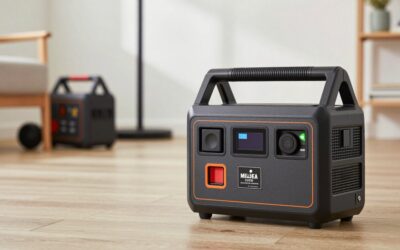
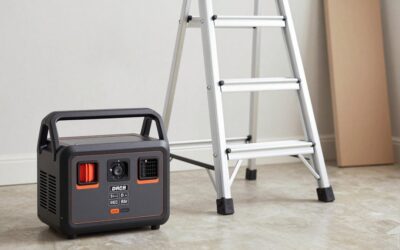
Jackery Explorer 300 Portable Power Station,292Wh
Included for 'Best Power Solution for RV Boondocking: Generator or Power Station?' because the listing specifies 292Wh, details this guide uses to compare options.
View on Amazon
Pulsar PGD40ISCO Ultra Light Quiet 4000W Portable Gas Inverter Generator, white
Included for 'Best Power Solution for RV Boondocking: Generator or Power Station?' because the listing specifies white, details this guide uses to compare options.
View on Amazon
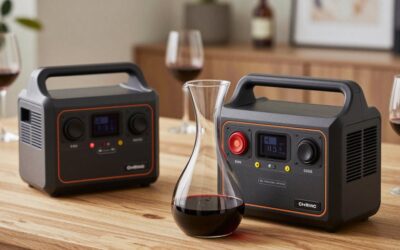
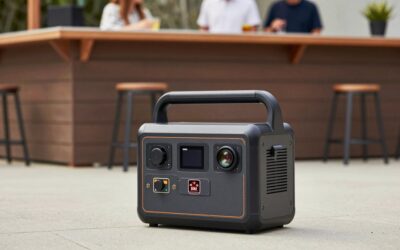
Anker SOLIX C2000 Gen2 Portable Power Station & 200W Bifacial Panel, 2048Wh
Included for 'Best Power Solution for RV Boondocking: Generator or Power Station?' because the listing specifies 2048Wh, details this guide uses to compare options.
View on Amazon
Champion 4000-Watt Dual Fuel RV Ready Portable Inverter Generator
Included for 'Best Power Solution for RV Boondocking: Generator or Power Station?' as a relevant option in this category; details come from the product listing.
View on AmazonThe generator approach
A 3,000 to 4,000W inverter generator, or an onboard propane or gasoline generator on many motorhomes, can recharge the house battery bank and run the AC or microwave at the same time. It works at night, in clouds, in winter, and under trees. For hot-weather boondocking with AC, it remains the only practical way to run a rooftop unit for hours.
Limits worth knowing
Many public lands and campgrounds restrict generator hours. Generator noise is a common source of friction in popular boondocking areas. Fuel must be hauled in: at moderate load a 3,000W-class inverter uses roughly 0.3 to 0.5 gallons per hour, so four hours of AC and charging daily burns about 1.5 to 2 gallons.
The battery-and-solar approach
Modern RVs increasingly use a lithium house bank of 200 to 600Ah at 12V (about 2.5 to 7.5 kWh) or a large portable power station, charged by 400 to 1,200W of rooftop solar. In the sunny Southwest, 800W of roof solar can harvest 3 to 4.5 kWh per day, covering every load except air conditioning. That setup is silent, has no hour restrictions, and requires no fuel runs.
Where it falls short
Rain, winter, and shaded forest camps cut solar harvest to a fraction. A string of four overcast days can drain even a large bank. Running a rooftop AC from batteries is possible with a big enough bank and soft start, but at 1.5 kW per hour, a 5 kWh bank buys only about three hours.
Comparison for a 10-day stay
| Factor | Generator-centered | Lithium/power station + solar |
|---|---|---|
| Runs AC for hours | Yes | 2–4 hours at best |
| Works in cloudy weather | Yes | Limited by stored capacity |
| Noise and hour limits | Yes, both | None |
| Fuel to haul for 10 days | 10–25 gal gas or propane | None |
| Upfront cost range | $900–3,000 | $2,000–8,000+ |
| Maintenance | Oil changes every 50–100 h | Minimal |
The setup most full-time boondockers end up with
The winning combination is batteries and solar as the primary system, with a small inverter generator as the backup. Solar and lithium run the rig silently most days. The generator comes out during stormy stretches, in winter, or for a couple of afternoon hours of AC during a heat wave, recharging the bank at the same time. Because the generator only fills gaps, a 2,000 to 3,000W unit is usually enough, and it may run only a handful of hours per week.
FAQ
How much solar do I need to boondock without a generator?
In sunny climates, 600 to 1,000W of rooftop solar and 400Ah or more of lithium storage covers a typical no-AC rig indefinitely. In cloudy or forested areas, even 1,200W may not keep up, so a backup generator is wise.
Can a portable power station replace an RV house battery?
A large station of 3 to 6 kWh can power a small trailer through its shore power cord, but it bypasses the RV’s 12V charging integration. Many owners prefer a built-in lithium bank with a proper inverter-charger.
Bottom line
For boondocking without air conditioning, batteries plus rooftop solar are the best primary system, quiet and free to run. For desert summers or cloudy seasons, keep a 2,000 to 3,500W inverter generator as the backup that runs the AC and refills the bank when the sun cannot.


Write Your Review
No reviews yet. Be the first to share your experience!