
🛒 Best Price Today on Amazon
Prime members get fast, free shipping on everything above, plus member-only deals. New members get a 30-day free trial — cancel anytime.
The Short Answer
It depends: you need a 240-volt generator only if you plan to power at least one appliance or circuit that requires 240 volts. A generator rated for 120 volts can run ordinary household devices—refrigerators, lights, televisions, chargers, sump pumps, and many small tools—but it cannot properly supply a 240-volt well pump, electric range, central air conditioner, electric dryer, or similar equipment.
The key detail is not simply the generator’s total wattage. A 6,000-watt generator that produces only 120 volts still will not operate a 240-volt appliance. Conversely, a 4,750-watt dual-voltage generator may provide 240 volts but lack enough running or starting power for a large air conditioner or well pump.
As an Amazon Associate we earn from qualifying purchases at no extra cost to you.

Before buying, check the voltage listed on the appliance nameplate and confirm whether your home’s transfer equipment is compatible. For backup power during 2026 outages, voltage, wattage, connection method, and safety all matter.
What You Actually Get
A 240-volt portable generator usually produces split-phase power: two 120-volt legs that combine to deliver 240 volts. That is the same basic arrangement used by a typical North American home electrical service. The generator may have standard 120-volt household outlets, a 240-volt twist-lock outlet, or a larger outlet intended for connection to a transfer switch or interlock.
That flexibility lets you run ordinary 120-volt loads and selected 240-volt loads from one machine. However, it does not mean every outlet can deliver the generator’s full advertised wattage. A generator rated at 4,750 starting watts and roughly 3,800 running watts, for example, must divide available power among the connected circuits. The exact output also depends on the fuel type and the manufacturer’s specifications.
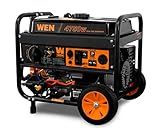
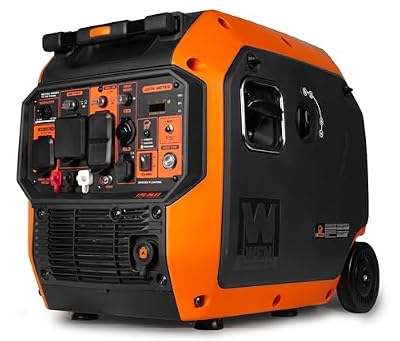
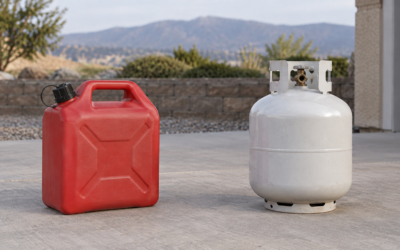
Dual-fuel models can run on gasoline or propane. Gasoline generally provides the higher output, while propane stores longer and can be useful when fuel stations are closed. A 4,750-watt dual-fuel model such as the WEN DF475T is a relatively compact choice for essential circuits and occasional 240-volt use; its listed price is about $465. A larger inverter model such as the WEN DF680iX is rated at 6,800 starting watts and is designed for RV use and electric-vehicle backup, with a listed price of about $798. Confirm its 240-volt operating specifications before using it for a particular appliance.
Expect portable generators in this class to be substantial machines. Depending on the frame, fuel system, and inverter design, many weigh approximately 100 to 180 pounds and measure roughly 25 to 35 inches long, 18 to 25 inches wide, and 20 to 28 inches tall. Wheels and a folding handle help, but these are not devices most people can safely lift alone.
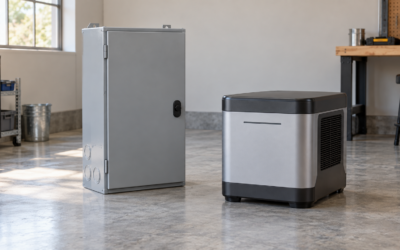
For home backup, a portable generator should normally connect through a properly installed manual transfer switch or approved interlock. Never plug a generator into a wall outlet to energize your home. That dangerous practice, called backfeeding, can send power onto utility lines and create a serious shock or fire hazard.
Pros
- Runs more appliances. A suitable 240-volt output can power equipment that a 120-volt-only generator cannot, including certain well pumps, furnaces, air conditioners, ranges, and dryers.
- Supports selected whole-home circuits. With correctly sized transfer equipment, you can choose essential circuits instead of relying only on extension cords.
- Offers 120-volt flexibility. Most dual-voltage generators still include standard outlets for refrigerators, lights, internet equipment, freezers, and chargers.
- Can provide more practical backup capacity. Larger 240-volt models often have enough output for several essential loads, provided their combined running and starting demands stay within the rating.
- Works well for certain workshops and RVs. Welders, air compressors, shop equipment, and some RV connections may require 240 volts or benefit from a higher-capacity generator.
- Dual fuel adds storage options. Propane avoids some long-term gasoline-storage concerns, while gasoline may offer greater output and easier refueling during a prolonged outage.
Cons
- Higher cost. A basic 120-volt generator may cost roughly $250 to $500, while a capable dual-voltage portable model commonly falls around $450 to $1,000 or more.
- More weight and noise. Larger engines, alternators, frames, and fuel tanks make these units harder to move and often louder than small inverter generators.
- 240 volts does not equal unlimited power. A generator can have the correct voltage and still fail to start a high-demand motor because of insufficient surge watts.
- Installation may be required. Powering home circuits safely can involve an electrician, a transfer switch or interlock, an inlet box, and code-compliant wiring.
- Some loads are poor matches. Central air conditioners, electric water heaters, dryers, and ranges can consume several thousand watts each. Running one may leave little capacity for everything else.
- Voltage balance matters. A large 120-volt load on one leg can limit usable capacity even when the generator’s total wattage appears sufficient.
- Inverter claims require careful checking. Some inverter generators offer cleaner power and quieter operation but have different outlet arrangements or limited 240-volt capability. Read the manual rather than assuming the word “inverter” guarantees a particular connection.
Who Should Buy It
Choose a 240-volt generator if your essential backup plan includes a 240-volt appliance. This is especially common in homes with a private well, where the pump may use 240 volts, or in regions where a furnace blower, boiler equipment, or central air system has that requirement. It may also make sense if you need backup power for a detached workshop, RV, large compressor, or selected farm equipment.
It is also a reasonable upgrade if you are installing a transfer switch and want more flexibility for future needs. A dual-fuel model in the roughly 4,000-to-7,000-running-watt class can be a practical middle ground for essentials, but size it from actual appliance nameplates rather than an optimistic guess. Add running watts, identify the largest starting surge, and avoid starting several motor loads simultaneously.
For example, a refrigerator may use only a few hundred running watts but require considerably more for a moment when its compressor starts. A well pump or air conditioner can have an even larger surge. Ask an electrician to verify the generator inlet, breaker arrangement, grounding, neutral bonding, and transfer equipment before connecting a 240-volt unit to a house.
Who Should Skip It
Skip 240 volts if your outage plan is limited to lights, phones, computers, a refrigerator, a freezer, a television, and a small microwave. Those are generally 120-volt loads, and a smaller 120-volt inverter generator can be easier to store, move, operate, and refuel. Many buyers never use the extra voltage they paid for.
You should also skip a portable 240-volt generator if you expect it to run an entire electric home. Electric resistance heat, a large water heater, a dryer, an oven, and central air can quickly exceed 10,000 watts together. A portable unit is usually intended for selected circuits, not unlimited whole-house operation. If your goal is seamless whole-home backup, compare a professionally installed standby generator and load-management system instead.
Cheaper Alternatives
| Option | Cost | Trade-off |
|---|---|---|
| 120-volt inverter generator, approximately 2,000 to 3,500 watts | $400-$900 | Quieter and easier to move, but cannot run 240-volt equipment and may not handle large startup surges. |
| Conventional 120-volt portable generator, approximately 3,000 to 5,000 watts | $250-$600 | Lower purchase price and useful for essential appliances, but typically louder, less fuel-efficient, and still limited to 120 volts. |
| Portable power station, approximately 1,000 to 2,000 watts | $500-$1,500 | No gasoline fumes or engine noise indoors, but limited runtime and usually unsuitable for high-wattage heating, pumps, or 240-volt appliances. |
| WEN DF475T dual-fuel 120V/240V generator | About $465 | Affordable voltage flexibility, but its roughly 3,800 running-watt class is not enough for every central HVAC system or whole-home load. |
| WEN DF680iX dual-fuel inverter generator | About $798 | More capacity and inverter-style output, but costs more and still requires careful checking of 240-volt outlet and transfer-switch compatibility. |
FAQ
Can a 120-volt generator run a 240-volt appliance?
No. Do not use adapters or combine random outlets to imitate 240 volts. The generator must be specifically designed to provide the correct split-phase 240-volt output, and the appliance must be connected through an appropriately rated receptacle and protection system.
Does a 240-volt generator use more fuel?
Voltage alone does not determine fuel use. Fuel consumption mainly follows the engine’s load and efficiency. Running a 240-volt appliance that consumes 3,000 watts will generally use more fuel than running a 120-volt load consuming 500 watts, but the difference comes from total power demand, not the number printed on the outlet.
How many watts do I need for a 240-volt appliance?
Use the appliance’s running watts plus its starting requirement. For motor-driven equipment, the startup demand may be several times higher than running consumption. If the nameplate lists amps instead of watts, a qualified electrician can help calculate the requirement; do not rely on a generic online estimate for a well pump or air conditioner.
Is a 240-volt generator enough for whole-house backup?
Usually not by itself. It can power selected circuits when paired with a properly sized transfer switch or interlock, but a typical portable unit cannot run every household appliance simultaneously. Make a priority list, calculate running and starting loads, and have the connection installed and inspected professionally.

Write Your Review
No reviews yet. Be the first to share your experience!