
🛒 Best Price Today on Amazon
Prime members get fast, free shipping on everything above, plus member-only deals. New members get a 30-day free trial — cancel anytime.
- Quick definitions
- Mistake 1: Buying by the big number on the box
- Mistake 2: Adding every appliance’s starting watts together
- Mistake 3: Forgetting that surges happen while other loads run
- Mistake 4: Assuming inverter and conventional surges are equal
- Mistake 5: Ignoring altitude, heat and fuel type
- Mistake 6: Overlooking soft starters and newer motors
- FAQ
- Bottom line
Running watts and starting watts appear on every generator box and every appliance chart, and most homeowners know there is a difference. Yet the same handful of mistakes show up again and again: buying on the wrong number, adding surges that never happen together, or ignoring the surge that actually trips the generator. Here are the misconceptions that matter, why they happen and how to avoid them.
Quick definitions
Running watts, also called rated or continuous watts, are what a generator can deliver steadily, or what an appliance draws once it is operating. Starting watts, also called surge or peak watts, are the brief extra power an electric motor needs to get moving, typically for a fraction of a second to a couple of seconds. For generators, starting watts is the short-term maximum the alternator and engine can supply.
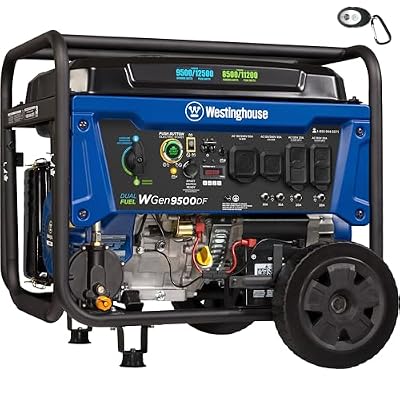
Westinghouse 12500 Watt Dual Fuel Home Backup Portable Generator, Remote Electric Start, Transfer Switch Ready, Gas and Propane Powered
Included for 'Running Watts vs Starting Watts: What Homeowners Get Wrong' because the listing specifies Remote Electric Start and Transfer Switch Ready, details this guide uses to compare options.
View on Amazon
Westinghouse 14500 Peak Watt Tri-Fuel Home Backup Portable Generator, Remote Electric Start, Transfer Switch Ready, Gas, Propane, and Natural Gas Powered
Included for 'Running Watts vs Starting Watts: What Homeowners Get Wrong' because the listing specifies Remote Electric Start and Transfer Switch Ready, details this guide uses to compare options.
View on Amazon
Westinghouse 4650 Peak Watt Portable Generator, RV Ready 30A Outlet, Gas Powered, CO Sensor
Included for 'Running Watts vs Starting Watts: What Homeowners Get Wrong' because the listing specifies RV Ready 30A Outlet and Gas Powered, details this guide uses to compare options.
View on Amazon
Westinghouse 6500 Watt Dual Fuel Home Backup Portable Generator, Transfer Switch Ready 30A Outlet, RV Ready 30A Outlet, CO Sensor
Included for 'Running Watts vs Starting Watts: What Homeowners Get Wrong' because the listing specifies Transfer Switch Ready 30A Outlet and RV Ready 30A Outlet, details this guide uses to compare options.
View on Amazon| Appliance | Running watts | Starting watts | Starting-to-running ratio |
|---|---|---|---|
| Space heater / toaster / kettle | 1,200 – 1,500 W | same | 1x (resistive) |
| Refrigerator | 100 – 250 W | 600 – 1,500 W | about 4 – 6x |
| Sump pump 1/2 hp | 800 – 1,050 W | 1,600 – 2,200 W | about 2 – 2.5x |
| Window AC 10,000 BTU | 800 – 1,200 W | 1,500 – 3,000 W | about 2 – 3x |
| Well pump 1 hp, 240 V | 1,500 – 2,000 W | 3,500 – 5,000 W | about 2.5 – 3x |
| Central AC 3 ton | 2,800 – 3,800 W | 6,000 – 12,000 W | about 2.5 – 4x |
Planning ranges only; check the current spec sheet or appliance label for actual figures, including LRA (locked rotor amps) on AC and pump nameplates.
Mistake 1: Buying by the big number on the box
Generators are marketed by their starting watts because it is the larger figure. A “4,000-watt” generator may deliver only 3,200 running watts. If your running load is 3,500 watts, that generator is too small no matter what the box says. Always compare your running total against the generator’s running rating.
Mistake 2: Adding every appliance’s starting watts together
Some people add up the starting watts of every appliance, producing an enormous number and an oversized generator. Motors rarely start at the same instant. The correct approach is to sum running watts, then add the largest single surge difference. The exception is after an outage, when many motors can try to start at once as power is restored; bring loads on one at a time to avoid that.
Mistake 3: Forgetting that surges happen while other loads run
The opposite error is sizing the surge in isolation. A generator comfortably running a 2,500-watt load still has to find the refrigerator’s 1,000-watt start on top of that when the compressor kicks in. Headroom has to cover the surge above the existing load, not just the surge alone.
Mistake 4: Assuming inverter and conventional surges are equal
Conventional generators with heavy alternators can often exceed their published starting rating briefly thanks to rotating mass. Inverter generators are electronically limited and cut out once their limit is reached. A 3,500-watt inverter and a 3,500-watt conventional generator may not start the same well pump. Where big induction motors are involved, look for real-world compatibility notes or choose extra margin with inverters.
Mistake 5: Ignoring altitude, heat and fuel type
Ratings assume sea level and moderate temperatures on gasoline. At 5,000 feet, expect roughly 15 to 18 percent less output. On propane, many dual-fuel generators lose about 10 percent. In high summer heat the engine also produces less. A generator that just covers your surge at sea level may fail in the mountains or on propane.
Mistake 6: Overlooking soft starters and newer motors
Many homeowners fight surge with a larger generator when a cheaper fix exists. Soft start kits for central and window air conditioners can reduce starting current by roughly 50 to 70 percent. Inverter-driven mini-split heat pumps and variable-speed compressors ramp up gradually and have little surge. Replacing an old refrigerator often cuts both running and starting watts.
FAQ
How long does starting surge last?
Usually a fraction of a second for small motors and up to 2 to 3 seconds for large, heavily loaded motors like well pumps or compressors starting against pressure.
Can I run a load above a generator’s running rating for a short time?
Briefly, yes, that is what the starting rating is for. Sustained operation above the running rating will trip the breaker or overload protection and can damage the generator.
Bottom line
Compare your running total to the generator’s running rating, add only the largest single surge on top of the loads already running, and derate for altitude, heat and propane. Avoid stacking every surge, and consider soft starters or variable-speed appliances before buying a bigger generator to handle one stubborn motor.
Write Your Review
No reviews yet. Be the first to share your experience!